

Along the former Western Front in France, Art & Jardins | Hauts-de-France is planting something new. Through its Gardens of Peace project, the French organization creates, nurtures, and promotes gardens on former World War I battlefields, each designed by landscape architects from a nation involved in the conflict. Together, they form places of memory for those who were lost and a message of hope for a more peaceful future.
Near Navarin, in Champagne, the American Garden of Peace stands as a testament to the indespensible contribution of U.S. soldiers to France’s defense, many of whom never left the battlefield. We spoke with Gilbert Fillinger, Director of Art & Jardins | Hauts-de-France, about how every element of the garden was carefully crafted by American and French landscape architects to honor the American soldiers who came to the aid of their French allies, and how the Gardens of Peace keep this defining moment in French-American friendship alive, with a second American garden now on the horizon.
Could you tell us about the history and origins of the American Garden of Peace? What is the particular significance of this garden in collective memory, and how did the partnership with Franco-American cultural organizations come about?
Navarin holds a unique place in the history of our two countries. We are at the heart of the former Champagne front, where the American contribution was decisive. In July 1918, the 42nd “Rainbow” Division went into the line near Souain alongside General Gouraud’s French Fourth Army and held firm against the last great German offensive. That fall, the 2nd and 36th Divisions, attached to the same army, took Blanc Mont Ridge, the highest point in Champagne, just a few miles from Navarin. The regiments of the 93rd Division, for their part, fought within French divisions west of the Argonne. More than 70,000 Americans served in the region in 1918.
After the war, General Gouraud wished to honor all the soldiers, French and Allied, who fell on the Champagne front. He initiated the Monument to the Dead of the Armies of Champagne, funded by a national public subscription and built on the site of Navarin Farm, of which no trace remains. The cornerstone was laid on November 4, 1923, in the presence of the U.S. Ambassador, Myron Herrick, and the United States was represented at its dedication on September 28, 1924.
At the summit, the sculptor Maxime Real del Sarte depicted three soldiers: General Gouraud, the sculptor’s own brother, killed at the Chemin des Dames, and an American soldier bearing the features of Quentin Roosevelt, the youngest son of President Theodore Roosevelt, an aviator shot down in July 1918. Carved into the base are the divisions that fought in Champagne, including the four American divisions. The ossuary holds the remains of 10,000 soldiers, most of them unknown.
This monument bears witness to what France and the United States went through together. The American garden is part of the Path of Peace that we have been building since 2018 along the former front line, from Belgium to Alsace: 29 Gardens of Peace to date and around 40 by 2028, each designed by landscape architects from a country involved in the conflict. When we extended this trail to the Grand Est region, working with the French Ministry of the Armed Forces and choosing sites within or near national military cemeteries, Navarin was the obvious choice for the American garden.
In collective memory, this garden offers another way of remembering. The ossuary carves memory in stone; the garden entrusts it to living things and turns us toward the future. Gardens and peace share the same fragility: both endure only through the care we give them. The constant attention the garden demands thus reminds us that peace must be tended and cultivated to preserve the friendship between peoples.
For the symbol to carry its full weight, it was essential to entrust this garden to a Franco-American artistic team. The international design competition launched in 2021 was won by David Simonson and Coralie Taupin. An American landscape architect, David Simonson trained in California, at California Polytechnic State University, then in France, at the École nationale supérieure de paysage in Versailles, before founding his practice in Paris. Coralie Taupin, a landscape designer shaped by the rural landscapes of Burgundy, works on heritage and agricultural sites. Born of a shared passion for art and landscape, their collaboration embodies, in the very design of the garden, the friendship it celebrates: two perspectives, two landscape cultures, brought together in a single project.
When is the official dedication planned?
The official dedication will take place in late spring or early summer 2027, during a ceremony organized with the French Ministry of the Armed Forces. It will be an important moment for the entire site: it will mark the reopening of Navarin following the restoration of the ossuary by the French Office for Veterans and Victims of War (ONaCVG), and the opening of a memorial trail at the heart of the site, along the former trenches.
The garden is therefore part of a broader project: making Navarin a place of learning and transmission, not only of remembrance. The ceremony will bring together representatives of the French government, the ONaCVG, local authorities, our donors and sponsors, local residents and veterans’ flag bearers, as well as the landscape architects David Simonson and Coralie Taupin. We would be delighted to welcome those in the United States who will have chosen to support the Gardens of Peace.
What are the key elements and characteristics of the garden’s design? What makes this garden unique or distinctive in the way it represents Franco-American friendship?
The designers started from the trench, the deepest mark the war left on this landscape, and turned its profile inside out. Where the 1918 trench sank into the ground, the “trench of peace” rises: about ten earthen berms, split down the middle, open onto the landscape. The parapet, over which soldiers fired, becomes a panoramic crest overlooking the Champagne plain; the fire step becomes a planted bench where visitors can sit, or even lie down. During the war, the trench was often a soldier’s only horizon; here, it opens up new perspectives.
Between the berms, thresholds and benches made of pink Vosges sandstone blocks, set like hyphens, allow visitors to pass from one to the next. This pink sandstone echoes that of the monument: the garden thus enters into direct dialogue with the ossuary that towers above it.
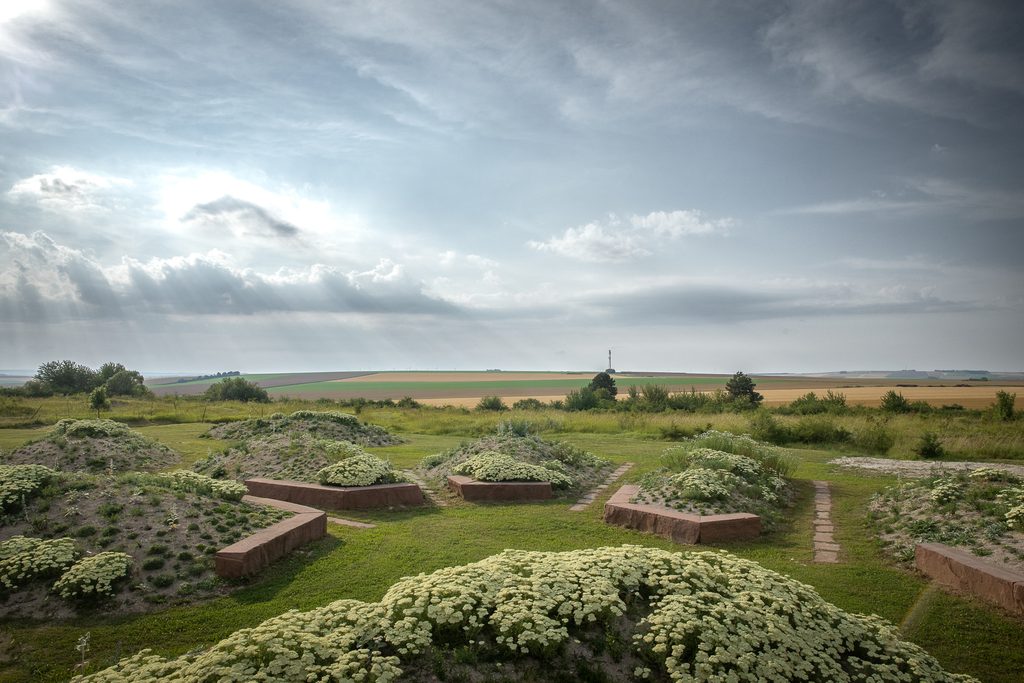
Within a footprint of about 2,400 square meters (roughly 26,000 sq ft), the garden includes 525 square meters (about 5,700 sq ft) of planted berms, home to more than 6,000 plants of seventeen varieties. Each berm has its own plant community, which over time will spread, mingle and coexist with the others: the garden is designed to evolve. Some species come from North America, such as heath aster (Aster ericoides) or frogfruit (Phyla nodiflora), others from Europe; all are adapted to dry soils and the harsh conditions of the site.
The garden also stands out for its restraint. It is never watered, on dry ground exposed to sun and wind. The landscape architects chose silvery foliage, mauve, blue and cream flowers, and above all groundcovers that carpet the gravel and shield the soil from the heat, such as Achillea crithmifolia. In midsummer, even through heat waves, it blooms.
What makes this garden unique is that, beyond its symbolic dimension, Franco-American friendship takes concrete form here: in its design, entrusted to a Franco-American team, and in its plants from both continents, which are learning to live together.
Beyond its physical beauty, what does the American Garden of Peace symbolically represent for Franco-American relations and cultural understanding? What message do you hope it conveys to visitors?
Lands of Promises speaks of the time it takes to rebuild, and of the importance of exchange in getting there. That is true of a devastated landscape; it is also true of the relationship between two peoples. The friendship between France and the United States is as old as the United States itself. It was built on mutual support and shared values of liberty and tolerance. The garden makes it visible on a site of mourning, and turns it toward the future. In 1917-1918, American soldiers crossed the Atlantic to fight on this land; a century later, an American landscape architect is growing a garden of peace here.
The garden’s design carries this message itself. The trench, dug for protection and combat, becomes a rise one climbs to look into the distance. What once divided becomes a place of passage, encounter and rest. The plant communities, separate at first, will mingle over the years: lasting harmony is born not of uniformity, but of coexistence.
The way this garden weathers drought also holds a lesson. It thrives not because it is protected from everything, but because it was designed to endure difficult conditions, thanks to the diversity of its plants. That balance did not come about overnight. Planted in fall 2023 with low groundcovers – thyme, yarrow, Roman chamomile, frogfruit – the garden was reworked as early as spring 2024: some plants had not taken, while others had settled in very well. The hardiest were reinforced, and more structural perennials – salvias, euphorbias and ornamental grasses – were added to fill it out.
It took many return visits to the site, careful observation and adaptation to conditions on the ground: the garden needed two years to find its balance (next spring there will be new plantation). Like peace, a garden is built patiently: it feels its way, adjusts, so that each can flourish with respect for the other.
The message we want to convey is simple: in war, there is never victory, nor any victor. Visitors are no longer merely witnesses to a tragic history: they become the keepers of a living, shared memory.
How do you hope people will experience and connect with this space?
The garden is open to all, free of charge. It welcomes remembrance tourism visitors, French and international, including Americans retracing their country’s engagement in 1918, just a few miles from the Sommepy American Monument on Blanc Mont Ridge, as well as local residents, families, and lovers of gardens and contemporary art. An American remembrance tour operator has in fact already included Navarin in its itineraries.
We think a great deal about younger generations. Each year, nearly 5,000 people take part in our peace education and outreach programs. At Navarin, the visit will unfold in three stages. The new memorial trail, along the former trenches, explains the battles and the daily lives of the soldiers. The ossuary, an imposing monument that stands out against the plain, confronts visitors with the reality of death and the brutality of war. The garden, connected to the landscape, provides the transition: it offers a place to pause, to soften one’s gaze, and to open oneself to peace.
What we hope is that visitors will take their time. That they will walk between the berms, sit down, look out over the Champagne plain. They do not need to know everything before they come. The garden invites them to see this landscape differently, and to ask themselves what peace demands of us today.
What role do gardens play in building and sustaining international connections?
A garden is never made alone. It takes a designer, a site, residents, gardeners, partners and funders. Each Garden of Peace is therefore, in itself, a concrete form of cooperation between countries.
Our approach makes this possible. Each garden begins with an international call for projects: we invite landscape architects from the nations involved in the conflict to create a garden on the sites where their soldiers fought. The winning team comes on site and works with local businesses and residents. Since 2018, we have created 29 gardens in three countries, with landscape architects of 26 nationalities and more than 750 volunteers. By 2028, around 40 gardens will form a Path of Peace stretching from Belgium to Alsace.
A garden is also a common language. No translation is needed to understand a bench, a patch of shade, a bloom. It belongs to all those who took part in a conflict, and that is what makes it a tool for bringing people together. The European Heritage Award / Europa Nostra Award, presented by the European Commission and Europa Nostra, which we received in 2026, recognizes precisely this ability to bring citizens together around a shared memory.
This international dimension is set to grow. New projects are emerging beyond the former Western Front, and we are currently preparing a major European project, which we would lead, to carry this message of peace across the continent. What was born on the 1914–1918 front line is thus becoming a European project, open to all those, on both sides of the Atlantic, who share the conviction that peace must be cultivated.
How U.S. donors can help
“Our partnership with Friends of Fondation de France carries this story forward. A century after the monument was dedicated, French and Americans can once again, together, bring these places of remembrance to life,” says Gilbert Fillinger.
With the support of American donors, a second American Garden of Peace could take shape in the Aisne department. The proposed site is near Fère-en-Tardenois, close to the Oise-Aisne American Cemeteries, where more than 6,000 American soldiers rest.
U.S. donors can help bring this second American garden to life with tax-deductible gifts made through Friends of Fondation de France. Gifts also help keep the gardens thriving by supporting their maintenance, and help educate young people through the development of an education and mediation program around Peace awareness.
Learn more about how to support Art & Jardins and the Gardens of Peace here.
Featured Photo ©yannmonel


